Crane Hand Signals
When the operator can’t see the load or the landing area, a qualified signal person guides the lift using standard hand signals, radio or other agreed methods.
- Construction
- General Industry
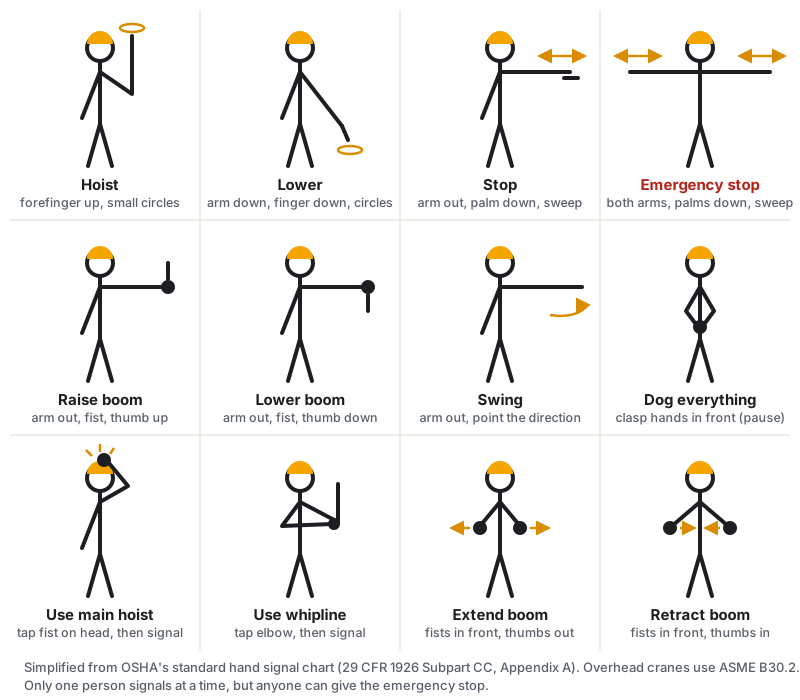
When a signal person is required
- The point of operation (load travel or landing area) isn’t in full view of the operator.
- The operator’s view in the direction of travel is blocked.
- Either the operator or the person handling the load decides it’s needed for safety.
Signal persons must be qualified: they know the signals, the basic operation and limits of the equipment, and have passed an evaluation.
Common signals
| Signal | How it’s given |
|---|---|
| Hoist | Forearm vertical, forefinger pointing up, move hand in small horizontal circles |
| Lower | Arm extended downward, forefinger pointing down, move hand in small horizontal circles |
| Stop | Arm extended, palm down, move arm back and forth horizontally |
| Emergency stop | Both arms extended, palms down, move arms back and forth horizontally |
| Raise boom | Arm extended, fingers closed, thumb pointing up |
| Lower boom | Arm extended, fingers closed, thumb pointing down |
| Swing | Arm extended, point with finger in direction of swing |
| Dog everything (pause) | Clasp hands in front of body |
| Use main hoist | Tap fist on head, then use regular signals |
| Use whipline (auxiliary) | Tap elbow with one hand, then use regular signals |
Anyone can give the emergency stop signal, and the operator must obey it immediately.
More standard signals
| Signal | How it’s given |
|---|---|
| Move slowly | Use one hand to give a motion signal and place the other hand motionless in front of it |
| Raise boom and lower load | Arm extended, thumb up, flex fingers in and out while the load moves |
| Lower boom and raise load | Arm extended, thumb down, flex fingers in and out |
| Extend boom (telescoping) | Both fists in front of body with thumbs pointing outward |
| Retract boom (telescoping) | Both fists in front of body with thumbs pointing toward each other |
| Travel | Arm extended forward, hand open and slightly raised, make a pushing motion in the direction of travel |
Overhead cranes in plants use a slightly different signal chart (ASME B30.2). Learn the chart for the equipment you work with.
Radio and other signals
- Test the radio with the operator before the lift and use a dedicated channel.
- Identify the crane and the action in each message, and keep talking during the move so the operator knows you’re still there. If the operator stops hearing you, the operator must stop.
- If you need a signal that isn’t on the chart, agree on it with the operator before the lift, and make sure it can’t be confused with a standard signal.
Signal person rules
- Stand where the operator can clearly see you, and where you can see the load, out of the line of fire.
- Wear high-visibility clothing or gloves.
- Only one signal person at a time, except for emergency stop.
- For radio signals, use a dedicated channel and confirm the radio works before the lift.
Video: demonstration of each standard crane hand signal
Standards & references
- 29 CFR 1926.1419–.1422: Signals
- 29 CFR 1926.1428: Signal person qualifications
- Subpart CC Appendix A: Standard hand signals
Last updated: