Electrical Panel Clearance
In an emergency, someone needs to reach the panel or disconnect fast, whether to shut off a machine that has caught someone or to kill power during a fire. Electricians also need room to work without brushing against something live. Blocked panels are one of the most common electrical violations in shops, warehouses, plants and jobsites.
- General Industry
- Construction
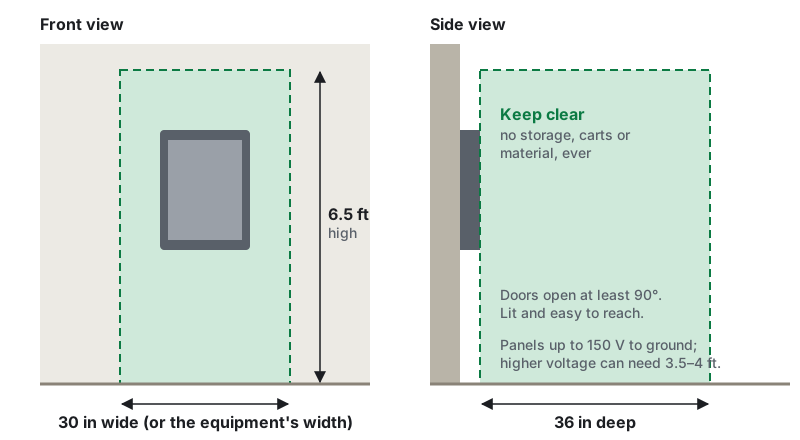
The working space
For most panels and equipment up to 150 volts to ground (typical 120/240-volt and 208Y/120-volt panels), the clear working space in front must be at least:
- 36 inches deep, measured out from the front of the panel
- 30 inches wide, or the width of the equipment if wider. The panel doesn’t have to be centered in the space.
- 6.5 feet high, or the height of the equipment if taller
Doors and hinged covers on the equipment must be able to open at least 90 degrees. The space must also have safe access, so you can get to it without climbing over things, and it must have lighting.
Higher voltages need more depth
For equipment between 151 and 600 volts to ground (like 480Y/277-volt panels in commercial and industrial buildings), the required depth depends on what’s across from the panel:
| What’s on the opposite side | 0–150 V to ground | 151–600 V to ground |
|---|---|---|
| Nothing live or grounded (or insulated) | 3 feet | 3 feet |
| Grounded parts, including concrete, brick or tile walls | 3 feet | 3.5 feet |
| Exposed live parts | 3 feet | 4 feet |
Large equipment may need two entrances to the working space so a worker can escape an arc flash or fire. The electrical code (NEC 110.26) has the details.
Labels, covers and openings
- Every disconnect and circuit breaker must be clearly labeled to show what it feeds, unless it’s obvious.
- Dead fronts and covers must be in place. Live parts operating at 50 volts or more must be guarded.
- Unused breaker openings must be closed with filler plates (blanks). An open slot is a finger-sized opening to live bus.
- Unused knockouts in boxes and panels must be closed.
- Arc flash and shock warning labels should be readable. See Arc Flash & NFPA 70E.
Keep panels safe
- Mark the floor in front of panels with paint or tape so nothing gets stored there.
- Keep panel doors closed.
- Keep the space above panels clear of pipes, ducts and storage that could drip or fall onto them.
- Report missing covers, open knockouts, scorch marks, buzzing, burning smells or heat.
- Know where the main disconnects are for your area, in case of emergency.
- Don’t store anything in the working space, not even “for a minute.”
- Don’t use the space in front of panels as a hallway to stack material or park carts.
- Don’t open a panel or reset a breaker that keeps tripping unless you’re authorized. Call an electrician.
- Don’t remove dead fronts unless you’re a qualified worker with the right PPE. See Qualified vs. Unqualified Workers.
Panel walk-around checklist
- 36 inches clear in front, 30 inches wide, 6.5 feet high
- Nothing stored in front or on top
- Door closes and latches
- All breakers and disconnects labeled
- No open breaker slots or knockouts
- No scorch marks, heat, buzzing or burning smell
- Area is lit and floor is dry
Standards & references
- 29 CFR 1910.303(f) and (g): Disconnect marking and space about electric equipment
- 29 CFR 1926.403(i): Working space (construction)
- NFPA 70 (NEC) 110.26: Spaces about electrical equipment
- See also: National Electrical Code
Last updated: