First Aid Basics
First aid fills the gap between an injury and professional medical help. On a remote or large jobsite, that gap can be 10, 20 or 30 minutes. What the first person on the scene does in those minutes can save a life or a limb. This page is a refresher, not a replacement for a hands-on first aid and CPR class.
- Construction
- General Industry
- Home
Check, Call, Care
- Check the scene before you go in. Look for traffic, moving equipment, live electricity, falling objects, fire, unstable trenches, and bad air in confined spaces. If the scene isn’t safe, don’t become the second victim. Call for help and wait for rescuers with the right equipment.
- Call 911, or point at one specific person and tell them to call: “You in the orange vest, call 911 and come back.” Send someone else to the gate or road to meet the ambulance and guide it in.
- Care for the person within your training. Put on gloves, check whether they’re responsive and breathing, stop severe bleeding, and keep them still, warm and calm until help arrives.
What to tell 911
- Exact location: street address, gate number, building, floor and closest cross street. Jobsites often don’t have a mailing address yet, so know the location before an emergency. GPS coordinates can help on rural sites.
- What happened: “A worker fell about 15 feet from a scaffold” is better than “someone got hurt.”
- How many people are hurt and whether they’re awake and breathing.
- Hazards responders need to know about: power lines, chemicals, trench collapse, confined space, fire.
- Stay on the line until the dispatcher tells you to hang up. They can coach you through CPR and bleeding control.
Tip: Post the site address and directions at the trailer, the gate and the first aid kit. Your foreman should know where the nearest hospital and trauma center are, and how long it takes to get there.
Protect yourself first
Treat all blood and body fluids as if they could carry disease. Wear the disposable gloves from the first aid kit, use a CPR face shield or mask, and wash your hands afterward. If you get blood in a cut, your eyes or your mouth, report it right away so you can get medical follow-up. See Bloodborne Pathogens.
The first checks
- Are they responsive? Tap their shoulder and shout, “Are you OK?”
- Are they breathing normally? Look at the chest for no more than 10 seconds. Gasping is not normal breathing.
- Not breathing, or only gasping? Start CPR and send for the AED. See CPR & AEDs.
- Severe bleeding? Press hard on the wound right away. Use a tourniquet for life-threatening limb bleeding. See Severe Bleeding Control.
- Then look for other injuries, ask what happened, and ask about allergies, medical conditions and medications.
Don’t move them, unless…
After a fall, a vehicle strike or a blow to the head, assume the person may have a neck or back injury. Keep them still and support their head in the position you found it. Only move an injured person if they’re in immediate danger (fire, traffic, collapse, rising water) or you have to move them to give CPR.
The recovery position
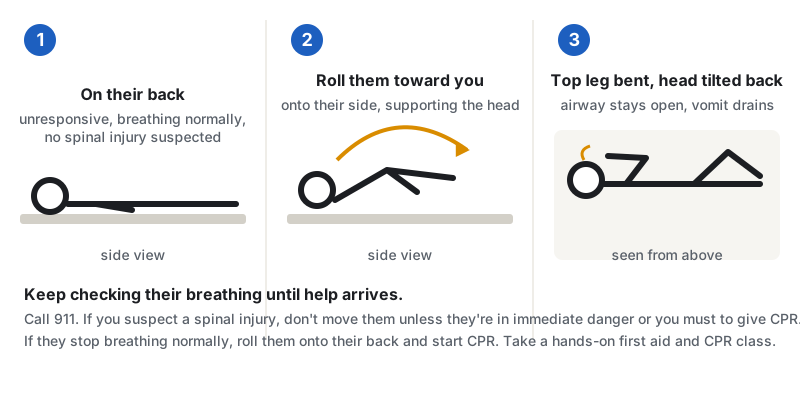
If someone is unresponsive but breathing normally and you don’t suspect a spinal injury, roll them onto their side, with the top leg bent and the head tilted slightly back. This keeps the airway open and lets vomit drain. Keep checking their breathing until help arrives.
Shock
Shock means the body isn’t getting enough blood flow. It can follow any serious injury, heavy bleeding, burns or a severe allergic reaction, and it can kill.
- Signs: pale, cool, clammy skin; fast, weak pulse; fast breathing; confusion, anxiety or drowsiness; nausea; thirst.
- What to do: call 911, control bleeding, have the person lie down, keep them warm with a blanket or jacket (under them too, if they’re on cold ground), and reassure them. Don’t give food or drink.
Common jobsite injuries
| Injury | What to do |
|---|---|
| Cuts and scrapes | Apply pressure to stop bleeding, rinse with clean water, cover with a sterile dressing. Get medical care for deep or gaping cuts, cuts from dirty or rusty objects, or if the person isn’t current on tetanus shots. |
| Severe bleeding | Direct pressure, wound packing, tourniquet. See Severe Bleeding Control. |
| Puncture wounds, nail gun injuries | Don’t pull out an embedded nail, rebar or other object. Stabilize it with bulky dressings and get medical care. Nail gun injuries often need X-rays. |
| Eye injuries | Flush chemicals with clean water for at least 15 minutes. Don’t rub the eye. Don’t remove an embedded object; cover both eyes loosely and get care. See Eyewash Stations. |
| Burns | Cool with cool running water for at least 10 to 20 minutes. Remove rings and watches before swelling starts. Cover loosely. See Burn First Aid. |
| Broken bones and sprains | Keep the injured part still in the position found. Splint only if you’re trained and help is far away. Apply a cold pack wrapped in cloth. Never try to straighten a broken bone. |
| Head injuries | Call 911 for loss of consciousness, confusion, vomiting, unequal pupils, seizures or clear fluid from the nose or ears. Even if they seem fine, a worker with a head injury should be checked by a medical provider and not drive. |
| Electric shock | Make sure the power is off before you touch the person. Call 911, even if they seem OK, because electricity can cause hidden heart and internal injuries. Start CPR if needed. |
| Crush injuries | Call 911. Control bleeding. Rescue from under heavy loads should be guided by emergency responders when possible. |
| Amputations | Control bleeding first (tourniquet), then save the part. See Amputation Injuries. |
| Chemical on the skin | Remove contaminated clothing and flush with lots of water for at least 15 minutes. Check the Safety Data Sheet for first aid steps. See SDS. |
| Heat illness | Move to shade, cool the person fast and call 911 for confusion or collapse. See Heat Illness. |
| Cold stress | Move to a warm place, remove wet clothing, warm gradually. See Cold Stress. |
| Bee stings and allergic reactions | Scrape the stinger out. Call 911 for trouble breathing, swelling of the face or throat, or hives all over. Help the person use their epinephrine auto-injector if they have one. |
| Fainting | Lay the person down and raise their legs if there’s no injury. If they don’t wake up within a minute, call 911. |
| Seizures | Clear the area, cushion the head, and don’t hold them down or put anything in their mouth. Time the seizure. Call 911 if it lasts more than 5 minutes or it’s their first one. |
| Suspected overdose | Call 911, give naloxone if available, and support breathing. See Overdose Response. |
Heart attack and stroke warning signs
- Heart attack: chest pain, pressure or squeezing; pain spreading to the arm, jaw, neck or back; shortness of breath; cold sweat; nausea; lightheadedness. Women and older workers often have less obvious symptoms. Call 911. Don’t let them drive themselves.
- Stroke (BE FAST): Balance loss, Eyes (vision loss), Face drooping, Arm weakness, Speech trouble, Time to call 911. Note the time symptoms started.
First aid kits
Jobsite kits should meet ANSI/ISEA Z308.1. Class A kits cover common injuries. Class B kits have more and larger supplies for higher-risk or more remote work, including a tourniquet. Many crews add a separate bleeding control kit and an AED.
- Kits are in a weatherproof container and easy to find, with a sign
- Everyone knows where the nearest kit and AED are
- Kits are checked at least weekly on construction sites, and used items are replaced
- Expired items (eyewash, ointments, medications) are replaced
- Company trucks and remote crews carry their own kits
What OSHA requires
- If there isn’t an infirmary, clinic or hospital reasonably accessible to the worksite, a person with valid first aid training must be available at the site. For workplaces where life-threatening injuries such as falls, suffocation or severe bleeding can happen, OSHA has interpreted “reasonably accessible” to mean emergency care within 3 to 4 minutes. That usually means having trained first aid responders on site.
- First aid supplies must be easy to get to. On construction sites, kits must be checked before being sent out to each job and at least weekly.
- There must be a way to get an injured worker to care quickly or to call an ambulance. Where 911 isn’t available, emergency phone numbers must be posted.
- Where workers may be exposed to corrosive chemicals, quick-drenching or flushing facilities (eyewash, showers) must be provided.
Good Samaritans
Every state has a Good Samaritan law that protects people who help in an emergency in good faith, within their training. The details vary by state, and workers designated as responders by their employer may be covered differently. If you’re trained, act. Doing something reasonable is almost always better than doing nothing.
After the emergency
- Report the injury to your supervisor right away, even if it seems minor. See Reporting Injuries.
- Restock the first aid kit and replace any used AED pads.
- Talk about what happened. Seeing a serious injury is hard, and it’s normal to feel shaken. Ask about your employer’s employee assistance program.
Standards & references
- 29 CFR 1926.50: Medical services and first aid (construction)
- 29 CFR 1910.151: Medical services and first aid (general industry)
- OSHA: Medical and first aid
- ANSI/ISEA Z308.1: Minimum requirements for workplace first aid kits and supplies
Related: CPR & AEDs · Severe Bleeding Control · Emergency Action Plans · Home First Aid Kit
Last updated: