Holes, Floor Openings & Covers
Workers fall through roof holes, floor openings, shafts and skylights every year. Usually a cover was removed and not replaced, wasn’t secured, wasn’t strong enough, or wasn’t marked, so someone picked it up or stepped on it without knowing what was underneath.
- Construction
- General Industry
What counts as a hole
In construction, a hole is a gap or void 2 inches or more in its smallest dimension in a floor, roof or other walking surface. That includes:
- Floor and roof penetrations for pipes, ducts and conduit
- Stairwell and elevator shaft openings
- Skylights and smoke vents
- Openings left for equipment, chutes and hoists
- Gaps between decking, planks or precast pieces
What OSHA requires
- Workers must be protected from falling through holes (including skylights) 6 feet or more above a lower level, using covers, guardrails or personal fall arrest.
- Workers must also be protected from tripping or stepping into smaller holes, using covers.
- People below must be protected from objects falling through holes, using covers.
- General industry has similar rules for holes 4 feet or more above a lower level.
Hole cover requirements
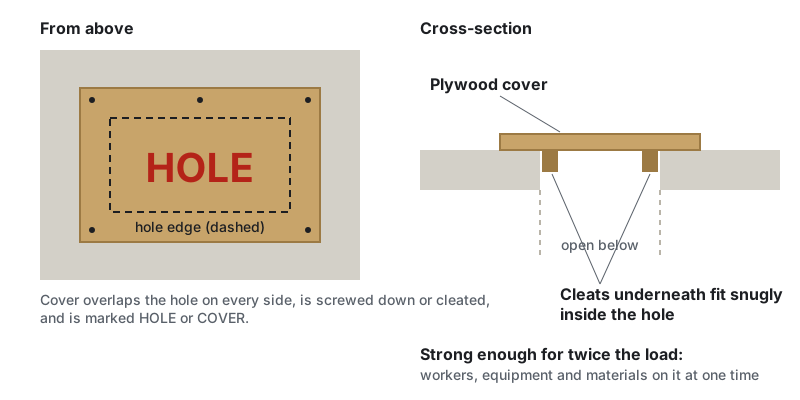
- Strong enough to hold at least twice the weight of the workers, equipment and materials that may be on it at one time
- Covers in roadways and vehicle aisles must support at least twice the axle load of the largest vehicle expected
- Secured so wind, equipment or workers can’t accidentally move it (screwed down, or cleats underneath that fit inside the hole)
- Marked with the word “HOLE” or “COVER”, or color-coded under the site’s system
- Larger than the hole, with enough overlap on all sides so it can’t drop in
Building a good plywood cover
- Measure the hole and cut the cover several inches larger on every side.
- Use plywood thick enough for the span and load (many sites require at least 3/4-inch for floor holes). Large openings need framing or engineered covers.
- Add cleats underneath that fit snugly inside the hole, or screw the cover to the deck.
- Spray-paint “HOLE” or “COVER” in large letters, and paint the edges a bright color.
- Never use a cover for storage or as a work table.
Skylights
Skylights are not designed to hold your weight, even if they look solid. Plastic domes get brittle in the sun, and painted or dirty skylights can look like part of the roof. Protect them with screens, covers or guardrails rated for the load, or use personal fall arrest.
Removing a cover
Danger: Never lift, move or step on a hole cover without knowing what’s underneath. If you remove a cover to work, guard the hole with guardrails or use fall arrest, and replace the cover the moment you’re done.
- Get permission from your supervisor before removing a cover. Many sites limit this to authorized workers.
- Tell other crews nearby that the hole is open.
- Stay tied off or behind guardrails while the hole is open.
- Replace and re-secure the cover before you leave, even for lunch.
- Don’t use cardboard, thin plywood, drywall or tarps as covers.
- Don’t sit or lean on skylights.
- Don’t leave a hole unprotected “just for a minute.”
- Don’t cut a new hole without a plan to cover or guard it immediately.
Daily hole check
- Walk your area and find every new hole cut since yesterday
- Check each cover is in place, secured and marked
- Check guardrails around larger openings and shafts
- Check skylights are screened, covered or guarded
- Report any missing or damaged cover immediately
Standards & references
- 29 CFR 1926.501(b)(4): Holes
- 29 CFR 1926.502(i): Covers
- 29 CFR 1910.28(b)(3) and 1910.29(e): Holes and covers (general industry)
Last updated: