Personal Fall Arrest Systems (PFAS)
A personal fall arrest system stops you after you fall, before you hit the level below. It has three main parts, the ABCs, and all of them must work together.
- Construction
- General Industry
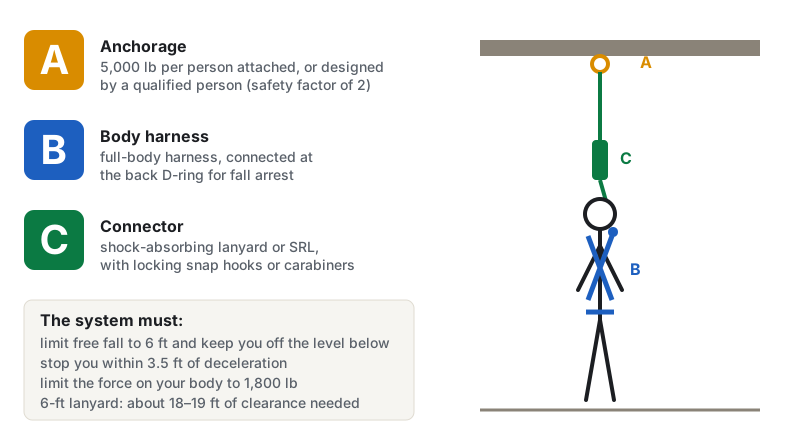
The ABCs
- A – Anchorage: a secure point to tie off to. Must support 5,000 pounds per person attached, or be designed by a qualified person with a safety factor of two. See Anchorage Points.
- B – Body harness: a full-body harness. Body belts are not allowed for fall arrest. See Harness Inspection & Fitting.
- C – Connector: a shock-absorbing lanyard, self-retracting lifeline (SRL), or rope grab on a vertical lifeline, with locking snap hooks or carabiners.
- Some trainers add D – Deceleration and R – Rescue.
Key OSHA limits
- Free fall no more than 6 feet, and you can’t hit a lower level.
- Deceleration distance no more than 3.5 feet.
- Maximum arresting force on the body no more than 1,800 pounds with a harness.
- Snap hooks and carabiners must be self-closing and self-locking.
Fall clearance: will you hit the ground?
For a 6-foot shock-absorbing lanyard anchored at your D-ring height, a common estimate of the clearance you need below the anchor is:
| Lanyard length | 6 ft |
| Shock absorber deceleration | 3.5 ft |
| Harness stretch and D-ring shift | about 1 ft |
| D-ring to bottom of your feet | about 5 ft |
| Safety margin | 2–3 ft |
| Total | about 18–19 ft |
Always use the manufacturer’s clearance chart for your exact equipment. If you don’t have enough clearance, use a self-retracting lifeline, anchor higher, or use fall restraint instead.
Watch out for swing falls: if you work off to the side of your anchor, you’ll swing like a pendulum when you fall and can hit nearby structures. Keep your anchor as directly overhead as possible.
Choosing a connector
| Connector | Best for | Watch out for |
|---|---|---|
| 6-foot shock-absorbing lanyard | Overhead or D-ring-height anchors with plenty of clearance | Needs about 18 feet or more of clearance |
| Self-retracting lifeline (SRL) | Lower heights, moving around, less clearance | Must be anchored as the label allows; edge rating for foot-level anchors. See SRLs |
| Rope grab on a vertical lifeline | Roofs, suspended scaffolds, climbing | Grab must match the rope; lifeline anchored independently |
| Twin-leg lanyard | 100% tie-off while moving past obstacles | Stow the unused leg only where the manufacturer allows |
Before you use it
- Harness, connector and anchor inspected and compatible
- Anchor rated and located at or above the D-ring if possible
- Fall clearance checked for this equipment and this anchor
- Swing fall zone checked
- Snap hooks fully closed and locked, and attached in the right direction
- Rescue plan and rescue equipment ready
Rules for using a PFAS
- Anchor at or above your D-ring whenever possible.
- Use leading-edge rated SRLs when the line could run over a sharp edge.
- Remove from service any equipment that has arrested a fall.
- Have a rescue plan before you start. See Fall Rescue & Suspension Trauma.
- Don’t tie a knot in a lanyard or lifeline, or wrap it around a beam and hook back onto itself (unless designed for that).
- Don’t connect two lanyards together to make a longer one.
- Don’t attach to guardrails, conduit, pipes or ductwork that aren’t rated anchors.
Video: calculating fall clearance with a lanyard vs. an SRL
Standards & references
- 29 CFR 1926.502(d): Personal fall arrest systems
- 29 CFR 1910.140: Personal fall protection systems (general industry)
- ANSI/ASSP Z359: Fall protection code
Last updated: