Safety Net Systems
Safety nets catch workers who fall, without anyone having to clip in. They protect everyone working above them at once, which makes them useful on bridges, steel erection, large open structures and building facades where other systems are hard to use. But a net only works if it’s close enough, wide enough and in good shape.
- Construction
When nets make sense
- Bridge construction and repair, where workers move constantly over water or roadway
- Steel erection and large open floors before decking is complete
- Work where many trades are above the same open area
- Places where anchors for personal fall arrest are hard to find
Nets are a passive system: they work without any action by the worker. That’s a big advantage over harnesses, which only work if someone clips in.
How close and how wide
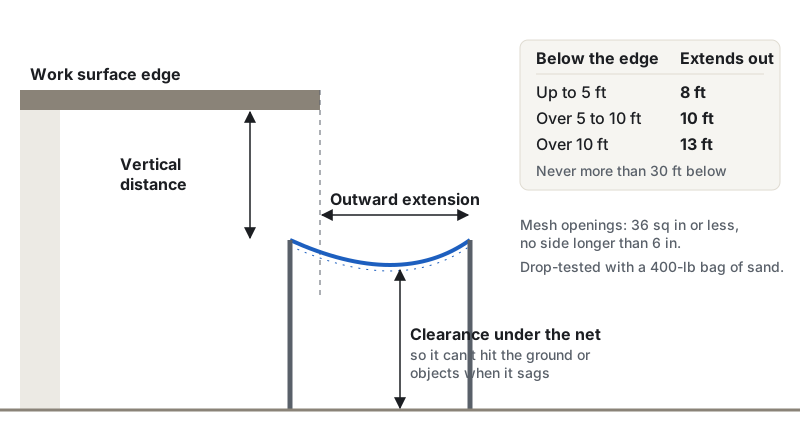
- Install the net as close as practical under the work surface, and never more than 30 feet below it.
- The net must extend outward from the edge of the work surface far enough to catch someone who falls outward:
| Vertical distance from work surface to net | Minimum horizontal distance from the edge |
|---|---|
| Up to 5 feet | 8 feet |
| More than 5 feet, up to 10 feet | 10 feet |
| More than 10 feet | 13 feet |
- Leave enough clearance under the net so a worker who lands in it doesn’t hit the ground, water, equipment or structure below when the net stretches.
Net construction
- Mesh openings no larger than 36 square inches and no longer than 6 inches on any side.
- Mesh crossings secured so the openings can’t enlarge.
- Border rope with a breaking strength of at least 5,000 pounds.
- Connections between net panels as strong as the net itself, and spaced no more than 6 inches apart.
Drop testing
Every personnel net must be drop-tested at the jobsite:
- After it’s first installed and before use
- Whenever it’s relocated
- After major repair
- At 6-month intervals if it stays in one place
The test drops a 400-pound bag of sand (about 30 inches across) into the net from the highest work surface the net protects, and at least 42 inches above that surface. If the employer can show a drop test isn’t reasonable, a competent person can certify the net instead, with a written record.
Inspection and housekeeping
- A competent person inspects the net at least once a week and after any event that could affect it, such as a fall, a dropped load or a storm
- No torn mesh, cut ropes, broken connections or damaged supports
- Damaged components are removed from service until repaired or replaced
- Debris, tools and materials are removed from the net as soon as possible, and at least before the next shift
- Nothing is stored in the net or hung from it
- Welding and cutting overhead are controlled so sparks don’t damage the net
Personnel nets vs. debris nets
A debris net (a fine liner) catches small falling objects. On its own, it isn’t designed to catch a person. Some systems combine a personnel net with a debris liner. Know which kind is installed before you rely on it.
If someone falls into the net
- Stop work above the net and call for help.
- Don’t climb into the net to reach the worker unless rescue procedures allow it. The extra weight can cause a second failure.
- Check the worker for injuries. Falls into nets can still cause bruises, sprains and neck injuries.
- Have the net inspected before work resumes.
Standards & references
- 29 CFR 1926.502(c): Safety net systems
- 29 CFR 1926.105: Safety nets (older general rule)
- ANSI/ASSE A10.11: Safety requirements for personnel and debris nets
Last updated: