Sling Hitches: Vertical, Choker & Basket
The same sling can lift very different weights depending on how it’s hitched and the angle of its legs. Every rigger needs to know how much capacity each hitch keeps, and how fast capacity drops as sling angles get flatter.
- Riggers
- Signal persons
- Crane operators
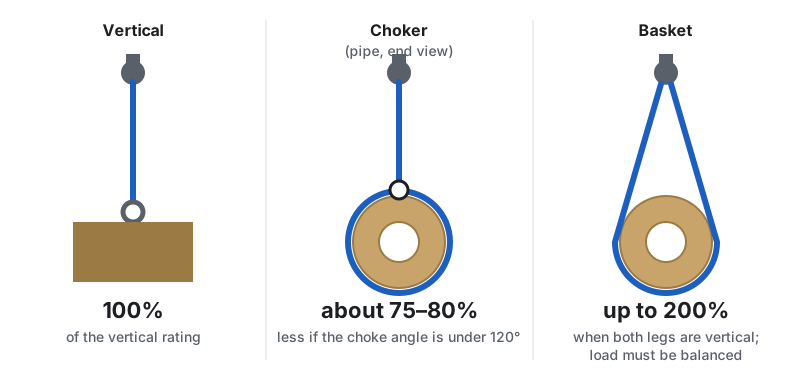
The three basic hitches
| Hitch | How it’s rigged | Capacity (compared with vertical) | Use and cautions |
|---|---|---|---|
| Vertical | One sling straight from hook to load | 100% | No control over rotation; use a tag line |
| Choker | Sling wraps around the load and passes through its own eye | Usually about 75–80%, and less if the choke angle is under 120° | Grips round loads and bundles; never pull the choke down by hand while lifting |
| Basket | Sling cradles the load with both eyes on the hook | Up to 200% when both legs are vertical, less as legs angle out | Load can slide or tip out unless balanced and controlled |
Always use the rated capacity on the sling’s tag for the hitch you’re using. The percentages above are general.
Sling angle
When sling legs angle out from the hook, each leg carries more than its share of the weight. The flatter the angle (measured from horizontal), the higher the tension.
| Sling angle from horizontal | Each leg’s capacity, as a share of its vertical rating |
|---|---|
| 90° (vertical) | 100% |
| 60° | about 87% |
| 45° | about 71% |
| 30° | 50% |
Avoid angles below 30°. Use longer slings or a spreader bar to keep angles steep. See Rigging Basics.
Choker tips
- Let the choke form naturally as the load is lifted; don’t force it down.
- Use a double-wrap choker for loose bundles of pipe or bar so they can’t slide out.
- Place the choke where it won’t bear on a sharp edge; use edge protection.
Basket tips
- Balance the load so it can’t tip or slide out.
- For wire rope baskets around small objects, the bend reduces capacity (D/d ratio); check the maker’s chart.
- Never use a single basket hitch on a load that isn’t balanced or can shift.
Before you hook up
- Load weight and center of gravity known
- Hitch chosen, and its rated capacity on the tag exceeds the load on that sling
- Sling angles checked
- Slings inspected; edges protected
- Tag line attached for control
Standards & references
- 29 CFR 1926.251: Rigging equipment for material handling
- 29 CFR 1910.184: Slings
- See also: Sling & Rigging Hardware Inspection · Synthetic Slings
Last updated: