Horizontal Lifelines
A horizontal lifeline (HLL) is a cable, rope or rail stretched between anchors so workers can move along a beam, roof, bridge or tank while staying connected. It looks simple, but the physics are not. A badly rigged horizontal lifeline can pull its anchors out or let a worker hit the ground.
- Construction
- General Industry
Photo: temporary cable horizontal lifeline on steel beams with energy absorber
Types of horizontal lifelines
| Type | Where you see it |
|---|---|
| Temporary cable or rope kits | Steel erection, bridge decks, roofs during construction. Installed and removed by the crew. |
| Permanent engineered cable systems | Rooftops, crane runways, loading racks and plant platforms. Installed by a specialist, inspected yearly. |
| Rigid rail systems | Truck and railcar loading, aircraft hangars and maintenance bays. A trolley rides in an overhead or wall rail. |
Why they need engineering
- Force multiplication: When someone falls on a tight horizontal line, the line pulls inward on the end anchors. The force on each anchor can be several times the force on the worker. Tighter lines make it worse.
- Sag: The line deflects downward during a fall. That sag adds to your total fall distance, often several feet.
- More users, more force: Two workers falling at once, or one falling and pulling on another, changes everything. Systems are rated for a set number of users.
- Span length: Longer spans sag more. Intermediate supports change how the line behaves.
That’s why OSHA requires horizontal lifelines to be designed, installed and used under the supervision of a qualified person, as part of a complete fall arrest system with a safety factor of at least two.
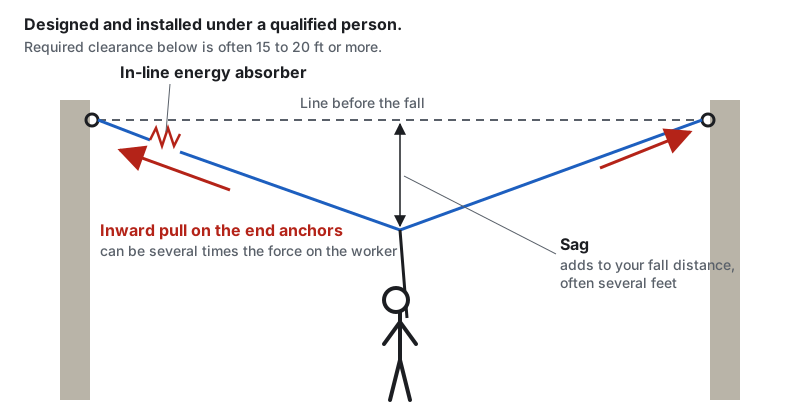
Fall clearance on a horizontal lifeline
Add up everything below the line before you work:
- Line sag during the fall (from the manufacturer’s chart for your span and number of users)
- Lanyard or SRL length and deceleration distance
- Harness stretch and D-ring shift
- Your height below the D-ring
- A safety margin
Required clearance on horizontal lifelines is often 15 to 20 feet or more. If you don’t have that much space below, the system may not work. See Calculating Fall Clearance.
Using a horizontal lifeline
- Use manufactured temporary HLL kits exactly as the instructions say: maximum span, number of users, anchor strength, tension and clearance.
- Attach end anchors to structure the qualified person has approved, such as beams or engineered anchors, not handrails or conduit.
- Check tension, the in-line energy absorber, end anchors and cable clamps before each use.
- Use the connector type the system specifies, usually a shock-absorbing lanyard or an SRL rated for use on a horizontal lifeline.
- Keep the line as high as possible, ideally at or above your D-ring, to reduce free fall.
- Plan where you’ll pass intermediate brackets without disconnecting, or use two lanyards.
- Have a written rescue plan. See Fall Rescue & Suspension Trauma.
- Don’t make your own lifeline from rope, wire rope and clips, or ratchet straps.
- Don’t over-tighten a cable with a come-along. Follow the kit’s tensioning method.
- Don’t put more workers on a span than the system is rated for.
- Don’t use a lifeline that has arrested a fall until a competent person has inspected it. Most must be removed from service.
- Don’t run the line over sharp edges without edge protection.
Daily check
- Labels are legible and show the span, user and clearance limits
- Cable has no kinks, broken wires, birdcaging or corrosion; rope has no cuts or burns
- Energy absorber is not deployed or stretched
- End anchors and intermediate brackets are tight and undamaged
- Tension is correct and the line is not touching sharp edges
- Fall clearance below the work area has been checked
Standards & references
- 29 CFR 1926.502(d)(8): Horizontal lifelines (construction)
- 29 CFR 1910.140(c)(12): Horizontal lifelines (general industry)
- ANSI/ASSP Z359.6: Specifications and design requirements for active fall protection systems
- See also: Anchorage Points · Personal Fall Arrest Systems
Last updated: