Leading Edge Work
A leading edge is the edge of a floor, roof, deck or formwork that keeps moving as new sections are installed. Because it changes constantly, guardrails are hard to keep in place, and workers are often standing right at the drop. Planning before the first sheet goes down is what keeps a decking or roofing crew alive.
- Construction
Where you find leading edges
- Metal decking on steel buildings
- Roof sheathing on wood-framed buildings
- Precast concrete planks and tees
- Concrete formwork and bridge decks
- Floor sheathing on multi-story framing
What OSHA requires
- Workers constructing a leading edge 6 feet or more above a lower level must be protected by guardrails, safety nets or personal fall arrest.
- Workers who aren’t building the edge but are on a walking surface near it must also be protected, the same way.
- If the employer can show those systems are infeasible or would create a greater hazard, a written, site-specific fall protection plan prepared by a qualified person may be used instead.
- Steel erection has its own rules (Subpart R), including a decking zone for trained deckers. See Steel Erection.
OSHA presumes conventional fall protection is feasible. The employer has to prove otherwise, and “it slows us down” isn’t enough.
Leading-edge SRLs
A standard self-retracting lifeline is designed for an anchor above your head. If you anchor at your feet and fall over an edge, the lifeline drags over the edge, which can cut it or overload the brake. A leading-edge-rated SRL (SRL-LE) is built and tested for that.
- Use an SRL-LE (ANSI Z359.14 Class 2 or labeled for leading edge) whenever the lifeline could pass over an edge in a fall.
- Check the label for the edge types it’s rated for. Many are tested on steel edges and are not rated for concrete or rough edges.
- Follow the minimum setback distance from the edge and the extra clearance the instructions require. Edge falls need more clearance than overhead falls.
- Anchor overhead when you can. Less free fall, less edge contact and less clearance.
Swing falls
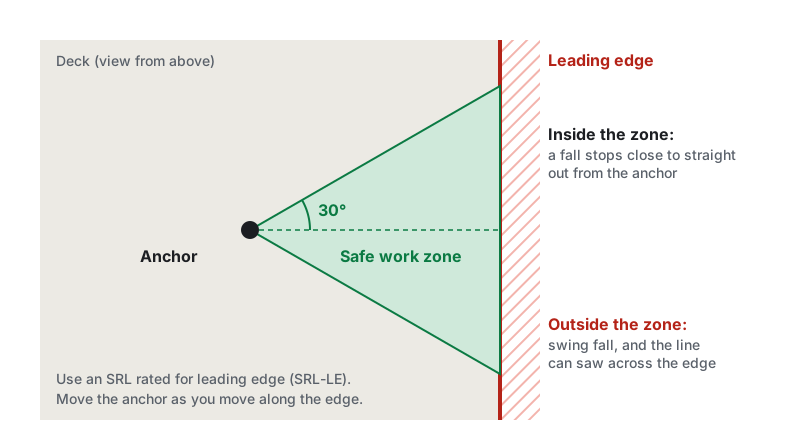
If you work far to the side of your anchor and fall, you swing like a pendulum. You can hit a column, the building or the ground, and the lifeline can saw across the edge. Keep your work zone within the angle the manufacturer allows (often about 30 degrees, or a set distance either side), and move the anchor as you move along the edge.
Controlled access zones and safety monitors
When a fall protection plan is used, it usually includes a controlled access zone (CAZ):
- Control lines (rope, wire or tape with flags at least every 6 feet) are set 6 to 25 feet back from the edge. Precast concrete erection allows up to 60 feet.
- Only workers who are trained and authorized for leading edge work may enter the zone.
- A safety monitor watches the workers in the zone. The monitor must be a competent person, on the same surface, in sight, close enough to talk to the workers, and must have no other duties.
Fall protection plans
A fall protection plan is only allowed for leading edge work, precast concrete erection and residential construction, and only when conventional systems truly can’t be used. The plan must:
- Be written for that specific site by a qualified person
- Explain why guardrails, nets and personal fall arrest are infeasible or more dangerous
- Identify each location where conventional fall protection won’t be used, and mark those areas as controlled access zones
- Describe the other measures that will be used to reduce the hazard
- Name the people authorized to work in those areas
- Be kept up to date at the jobsite, with changes approved by a qualified person
- Include a process to investigate any fall or close call and update the plan
Before the shift
- Walk the deck and identify every edge, opening and skylight
- Confirm anchors, SRL-LEs and harnesses are inspected and right for the edge type
- Check fall clearance below the edge
- Barricade or cover openings created as decking proceeds
- Review the rescue plan. See Fall Rescue
Standards & references
- 29 CFR 1926.501(b)(2): Leading edges
- 29 CFR 1926.502(g), (h) and (k): Controlled access zones, safety monitoring and fall protection plans
- 29 CFR 1926.760: Steel erection fall protection
- ANSI/ASSP Z359.14: Self-retracting devices (leading-edge Class 2)
Last updated: