Tractor-Trailers (Semis)
A loaded tractor-trailer can weigh 80,000 pounds and stretch more than 70 feet. It needs far more room to stop and turn than any car, and other drivers often don’t understand that. Professional semi drivers manage space, speed and weight every mile.
- Truck drivers
- Class A CDL
Stopping distance
At highway speed, a fully loaded tractor-trailer needs roughly the length of a football field or more to stop, even with good brakes on dry pavement, and much more on wet or icy roads. Total stopping distance includes:
- Perception distance: how far you travel before you recognize the hazard
- Reaction distance: how far you travel before your foot hits the brake
- Brake lag: the short delay for air brakes to apply
- Braking distance: how far the truck travels once the brakes are applied
A common rule is at least one second of following distance for every 10 feet of vehicle length, plus one more second above 40 mph. Add more in bad weather.
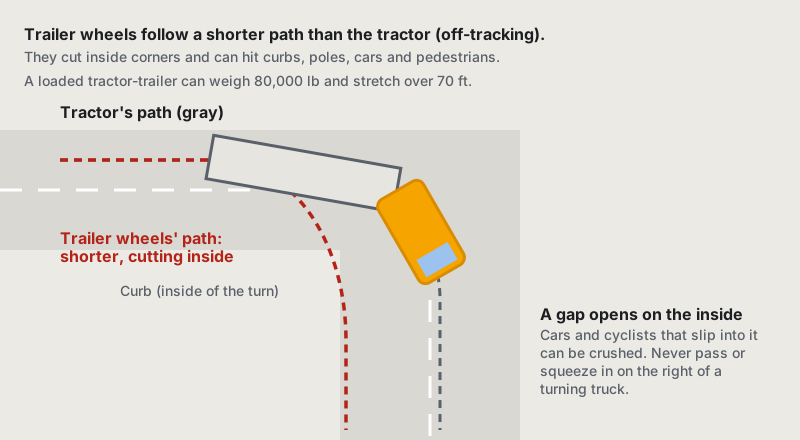
Turning and off-tracking
- Trailer wheels follow a shorter path than the tractor’s (off-tracking), cutting inside corners. They can hit curbs, poles, cars and pedestrians.
- On right turns, go straight farther into the intersection before turning, and keep the trailer close to the curb so cars can’t squeeze in on your right.
- Use mirrors constantly through the turn.
- Plan routes that avoid tight turns. If you’re stuck, ask for help or get out and look.
Weight distribution
- Gross weight, steer axle, drive axles and trailer axles all have limits. See Weight Limits & Scales.
- Sliding the trailer tandems or the fifth wheel shifts weight between axles. Lock pins must be fully engaged after sliding.
- Loads too high or off-center raise the risk of rollover. See Rollovers & Jackknifes.
Empty or light trailers
An empty trailer is easier to blow over in a crosswind and more likely to jackknife when braking hard, because there’s little weight on the trailer tires. Slow down in wind, avoid hard braking on slick roads, and know when to park.
Space management
- Keep a space cushion in front and to the sides; stay out of packs of cars.
- Look far ahead (12 to 15 seconds) to spot problems early.
- Check mirrors every few seconds.
- Signal early, and change lanes slowly.
- Know your height (often 13 feet 6 inches) and watch for low clearances.
Other topics for semi drivers
- Coupling & Uncoupling Trailers
- Backing & Docking
- No-Zones: Truck Blind Spots
- Mountain Grades & Brake Fade
- Hours of Service
Standards & references
- FMCSA: Our Roads, Our Safety
- Your state’s CDL manual: Combination Vehicles section
Last updated: